
TFS Brings Industry Voices Together at TIFF for a Conversation on Adapting Real Stories
In This Article
At the fifth season wrap party for Son of a Critch, the CBC comedy based on comedian Mark Critch’s childhood in St. John’s, executive producer Andrew Barnsley found himself in conversation with Critch’s real-life brother. Watching a version of his own family on screen, he told Barnsley, is a strange feeling. The characters on TV, however familiar, aren’t quite the parents and siblings he grew up with, but a version of them—close enough to recognize, different enough to notice.
It’s a small example of the bigger questions Toronto Film School set out to explore during its first-ever panel at the Toronto International Film Festival: what happens, creatively and personally, when real lives become screen stories.
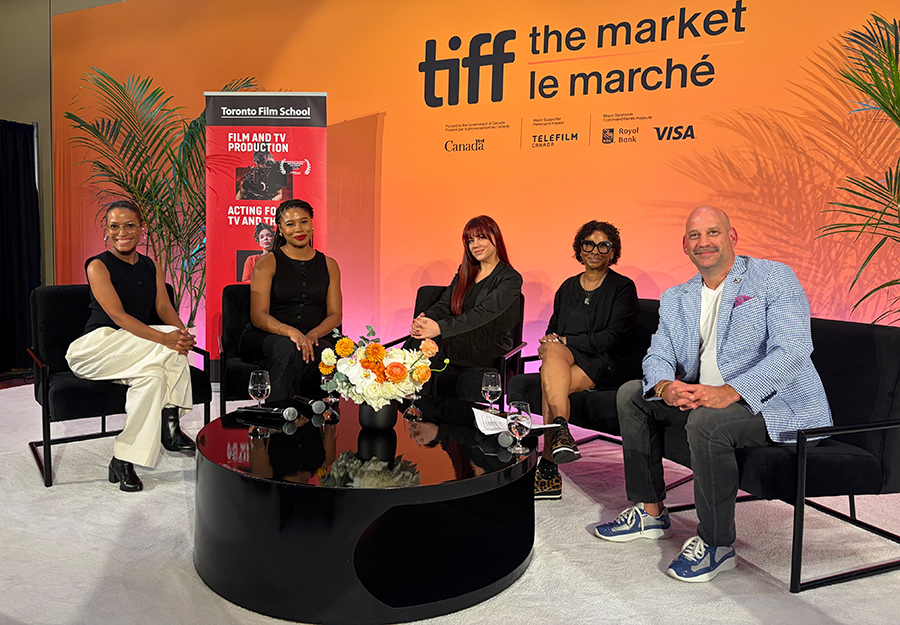
The panel, titled Adapting Real Stories Without Losing the Truth, brought together four Canadian film and television professionals at TIFF: The Market for a wide-ranging conversation about one of screen storytelling’s most challenging questions: how do you adapt a real story without losing the truth at its heart? Held at the Metro Toronto Convention Centre in downtown Toronto, the discussion delved into the creative, ethical and business considerations that come with transforming real people and events into compelling screen stories.
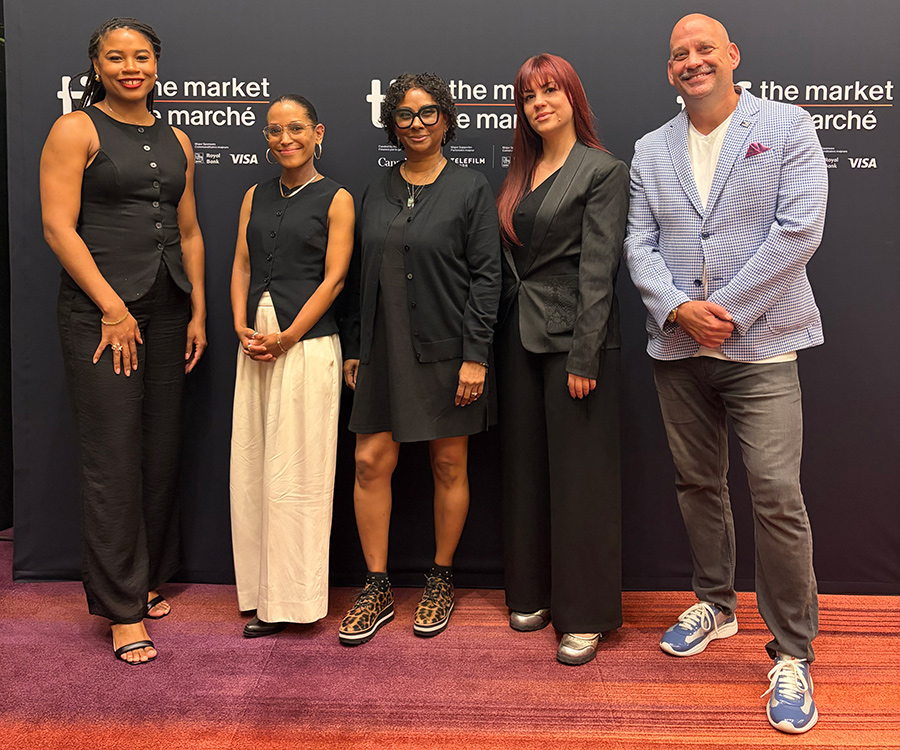
Barnsley—who serves as President of TFS and CEO of Project 10 Productions—moderated the discussion, which featured Barbara Mamabolo, Executive in Charge of Current Production for CBC Drama; Carolyn Mauricette, Director of Canadian Programming for Fantasia International Film Festival; Emilija Davidovic, Program Director of TFS’s Film & TV Production Diploma Program and an experienced producer and production supervisor; and TFS grad Caleigh Bacchus, a screenwriter, producer and story editor whose credits include Murdoch Mysteries, Diggstown, and Hate the Player: The Ben Johnson Story.
Finding the Emotional Truth
Over the course of the hourlong discussion, each panelist brought a different vantage point to the table—broadcaster, festival programmer, producer, writer—but the conversation kept returning to the same underlying questions: whose truth is being represented, and when does creative licence go too far?
For Mamabolo, whose CBC work includes adapting real stories for scripted television, the starting point is understanding the perspective through which a story is being told.
“Truth is subjective,” she said, emphasizing the importance of asking whose truth is being represented and why that perspective is relevant today. She also stressed the importance of approaching real stories with sensitivity and care, including maintaining relationships with the communities connected to them.
Ultimately, Mamabolo said, “the truth is the springboard, and finding the emotional truth within the themes that we’re exploring is what we are focused on—not so much the detail of what happened literally, but what is the emotional core of the narrative.”
For her, adapting a real story is less about reproducing every historical detail and more about finding its emotional truth and using that as the foundation for the characters and world being created.
Bacchus agreed that adaptations inevitably involve creative choices. The phrase “based on” provides some flexibility, she noted, and changes may sometimes be necessary for dramatic structure or legal reasons. As an example, she pointed to the film Remember the Titans, where the timing of a real-life car crash was changed to heighten the drama, while the spirit of what happened remained intact.
The challenge, she said, is knowing when creative licence goes too far.
“Once you stick with the integrity of the story, the choices you’re making ought to make it better, and not salacious,” she said, arguing that changes should serve the story rather than simply make it more sensational.
For Davidovic, the line is crossed when creative decisions fundamentally alter what made the original story meaningful: “The line is crossed when creative choices do not fortify the truth, but rather alter it drastically,” she said.
That principle can become particularly complicated when filmmakers have to fill gaps in the historical record. Davidovic described starting with traceable sources such as books, court records and expert consultations, while acknowledging that no collection of sources can answer every question—particularly when it comes to a real person’s internal thoughts and experiences.
Those gaps can create opportunities for creative interpretation, she explained, but audiences should be able to understand when a moment is interpretive rather than documented fact.
When the “Truth” Is Someone’s Own Version of Events
Bacchus’s work on Hate the Player: The Ben Johnson Story pushed the conversation somewhere less conventional.
Johnson, the Canadian sprinter whose 1988 Olympic gold medal and world-record performance in the 100 metres were stripped after he tested positive for steroids, has long been at the centre of one of sport’s most infamous doping scandals. Rather than chasing an outside, verified account of what happened, the mockumentary leans directly into Johnson’s own version of events—deliberately embracing his self-serving spin rather than correcting it.
Johnson had given the production his life rights and told his story to the writers directly, coming into the writers’ room twice and answering every question without holding anything back. The job from there, Bacchus said, was to stay true to his telling of it—spin and all.
That approach led to some of Bacchus’s favourite moments behind the scenes: “I think that with every project where you’re tackling the truth, the issues always come when you’re sending your scripts to the lawyers,” she said. “They come back and they’re like, you can’t say any of this.”
Rather than letting those restrictions shut down the storytelling, Bacchus said the team found a creative workaround.
“Our lawyer was so frazzled, that we decided to write him into the show,” she said, explaining that the lawyer would appear in scenes when the dialogue approached legally risky territory, interrupting the characters before they could say too much.
Johnson, for his part, watched everything. “He came to set one day, and he was cracking up,” Bacchus said. “He had a great time.”
In the end, Johnson embraced the finished product. Asked what he thought at the wrap party, his response was characteristically understated: “Yo, it was fine. I’m glad the truth is out there now.”
Authenticity in a Changing Industry
The panel also considered how audiences’ expectations of authenticity are changing, particularly as AI becomes increasingly present in film and television production—and the consensus was that audiences are only getting harder to fool.
“Audiences are very savvy. They will look things up,” Mauricette said, a reality that puts pressure on filmmakers to build trust rather than assume it.
That scrutiny extends to the writing itself: Bacchus noted that fact-checkers can challenge writers to explain their creative decisions, meaning a writer needs to be able to justify why they departed from the historical record—not just that they did.
What that trust is actually built from, though, is harder to pin down.
Davidovic described authenticity as something assembled from many elements at once—viewpoint, voice, performances, cinematography and editing—rather than any single ingredient a production can simply get “right.”
For Mamabolo, that same idea extended into something less technical and more human: even in fictional or escapist stories, audiences are drawn to an emotional truth that no amount of polish can fake: “I think that’s something that AI cannot capture,” she said.
Asking the Right Questions
Throughout the discussion, the panel returned to the idea that adapting a real story requires more than simply obtaining the rights to tell it. It requires filmmakers to ask creative, ethical and legal questions at every stage of the process.
For Davidovic, the framework is straightforward: creatively, does a choice strengthen the story? Ethically, does it preserve, amplify or unnecessarily change the truth? And legally, can the filmmakers actually make the choice?
It’s that combination of instincts—creative, ethical and legal—that the four industry professionals brought to the stage for TFS’s first-ever panel at TIFF, offering a rare look at the decisions that shape a true story long before it reaches the screen.

